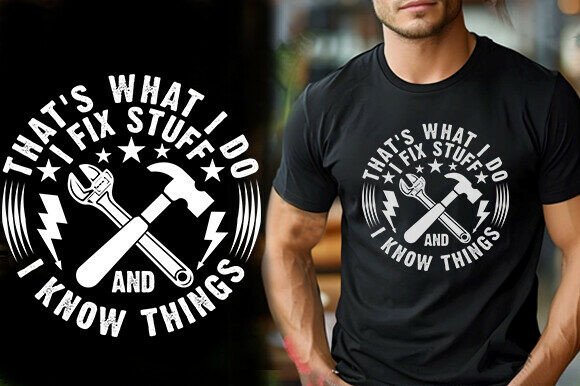
That S What I Do I Fix Stuff
When I pull a new design file into my hoop for testing, I am rarely looking at just a graphic. I am looking at a potential finished product, a brand statement, or a personalized gift that needs to survive the washing machine and still look professional. Recently, I evaluated a design titled THAT S WHAT I DO I FIX STUFF and I KNOW. On the surface, it falls under the broad categories of T-Shirt Designs and Graphics, but in the world of embroidery, those labels tell you nothing about stitch quality, visual balance, or marketability. As an experienced designer reviewing this asset for real-world application, I want to break down how this specific text-heavy layout performs when converted from pixels to thread.
The First Impression: Attitude Meets Utility
The immediate mood of THAT S WHAT I DO I FIX STUFF and I KNOW is one of confident utility. It does not whisper; it states. For an embroiderer, typography-driven designs are often the most challenging because they rely entirely on legibility and spacing. This design carries a strong personality that suggests reliability, expertise, and perhaps a touch of humor. It feels less like a decorative accent and more like a badge of honor. When I first laid out the concept mentally, I envisioned this on heavy-duty fabrics where the message could stand tall without getting lost in the weave. The phrase itself is catchy, rhythmic, and highly relatable for tradespeople, DIY enthusiasts, and anyone who takes pride in solving problems. It creates an instant connection with the wearer, signaling competence before they even speak.
Real-World Application: Where Does This Fit?
In my practice, I constantly evaluate which products will elevate a simple text design. THAT S WHAT I DO I FIX STUFF and I KNOW shines brightest on items that serve as uniforms or tools of the trade. Imagine this stitched onto a high-quality canvas tote bag design for a contractor heading to a job site. The durability required for such a bag pairs perfectly with the rugged nature of the quote. Similarly, sweatshirt embroidery is a natural home for this kind of bold statement. A crewneck sweatshirt offers a flat, stable surface that allows the lettering to breathe, making it ideal for cold-weather gear for mechanics, carpenters, or engineers.
I also see strong potential in smaller, personal items. A custom embroidered patch applied to a tool belt or a hard hat adds a layer of professionalism and ownership. For the craft business owner, this design translates well into holiday embroidery projects, particularly as gifts for fathers, husbands, or partners who are handy around the house. Personalized gifts become more meaningful when the design reflects the recipient’s identity, and this phrase does exactly that. It works equally well on aprons for the home chef who treats cooking as a serious craft, or on pillow covers for a man cave or workshop lounge. Even baby embroidery can find a place here, though perhaps in a softer font interpretation, creating a future heirloom for the child of a tradesperson.
Technical Considerations for Embroidery Designers
Before committing to production, any savvy embroiderer knows that digital previews can be deceiving. When evaluating THAT S WHAT I DO I FIX STUFF and I KNOW, you must consider the physical limitations of your machine and materials. Text-based graphics require precise digitizing to avoid puckering or distortion. If the stitch density is too high, the fabric will pucker; if it is too low, the letters may look sparse and unprofessional. You need to inspect small details closely, ensuring that thin lines or serifs do not disappear during the stitching process.
Fabric choice is critical. While this design looks great on structured cotton or denim, it requires careful handling on stretchy fabrics or textured weaves. Thin fabric may not support the weight of dense fill stitches, leading to visible backing material or warping. Dark fabric backgrounds can help the design pop, provided you select the correct thread colors for contrast. I always advise testing the design on scrap fabric first. Check the stabilizer compatibility—cut-away stabilizers are usually necessary for garments that will undergo frequent washing to maintain shape and clarity. Additionally, confirm whether the design works for both personal and commercial projects. Many digital embroidery file sellers provide different licensing tiers, and assuming you have the right to sell finished goods can lead to legal issues later.
Where Caution Is Required
There are specific scenarios where this design might struggle. Small hoop sizes can truncate longer phrases, so ensure the entire quote fits comfortably within your chosen dimensions. Curved surfaces, such as caps or hats, present a challenge for straight text lines; the curvature can make letters appear distorted unless the digitizing accounts for the curve’s radius. Dense stitch areas should be avoided on delicate items like tea towels or lightweight kitchen towels, as the stiffness left by the stabilizer can ruin the soft hand-feel of the fabric. Decorative accents or tiny lettering parts of the design must be scrutinized for clarity. If the design includes intricate elements alongside the main text, they may merge into a blob when stitched at smaller scales.
Visual Appeal and Brand Value
From a marketing perspective, THAT S WHAT I DO I FIX STUFF and I KNOW has high recognition value. It is memorable and shareable. For Etsy sellers and small shop owners, this means higher click-through rates on listings featuring clear, mockup images. The design conveys trust and professionalism, which are key factors in buyer engagement. When customers see a well-executed embroidery project, they perceive higher quality in the final product. This perception directly impacts your ability to price items competitively. A sloppy execution of a good design can undermine the brand, whereas a clean, crisp stitch job reinforces brand consistency.
Furthermore, this design lends itself well to printable mockups for digital product previews. Showing the design on various apparel types helps customers visualize the end result, reducing hesitation and increasing conversion. Whether you are selling the raw embroidery file or the finished handmade product, the versatility of this theme allows you to target multiple niches simultaneously—from automotive shops to home repair businesses.
Final Verdict for the Creative Entrepreneur
Evaluating THAT S WHAT I DO I FIX STUFF and I KNOW reveals a design that is practical, engaging, and commercially viable, provided it is executed with technical precision. It is not merely a graphic; it is a communication tool that resonates with a specific audience. By paying attention to stitch density, fabric texture, and proper stabilization, you can transform this text-based concept into a standout item. Test thoroughly, respect the limits of your equipment, and focus on the details. When done right, this design offers a perfect blend of attitude and craftsmanship, making it a valuable addition to any embroiderer’s portfolio or a small business’s inventory.